
Core strength & anti-extension exercises: Why are they important?
Anti-extension exercises resist your lower back from getting into a hyperextended position or ‘lumbar lordosis’. A hyperextended lumbar spine is a position that can hurt you especially if you are in that position when lifting heavy or heavy-ish weights.
Anti-extension exercises hence can be helpful for those struggling to keep a neutral spine with compound movements such as a deadlift, overhead press or squat. Also, for those w ith back pain when exercising in a lumbar extension bias position such as freestyle (swimming) or running.
Here are two exercises to help build resiliency in the ‘anterior core’ to avoid a hyperextended spine.
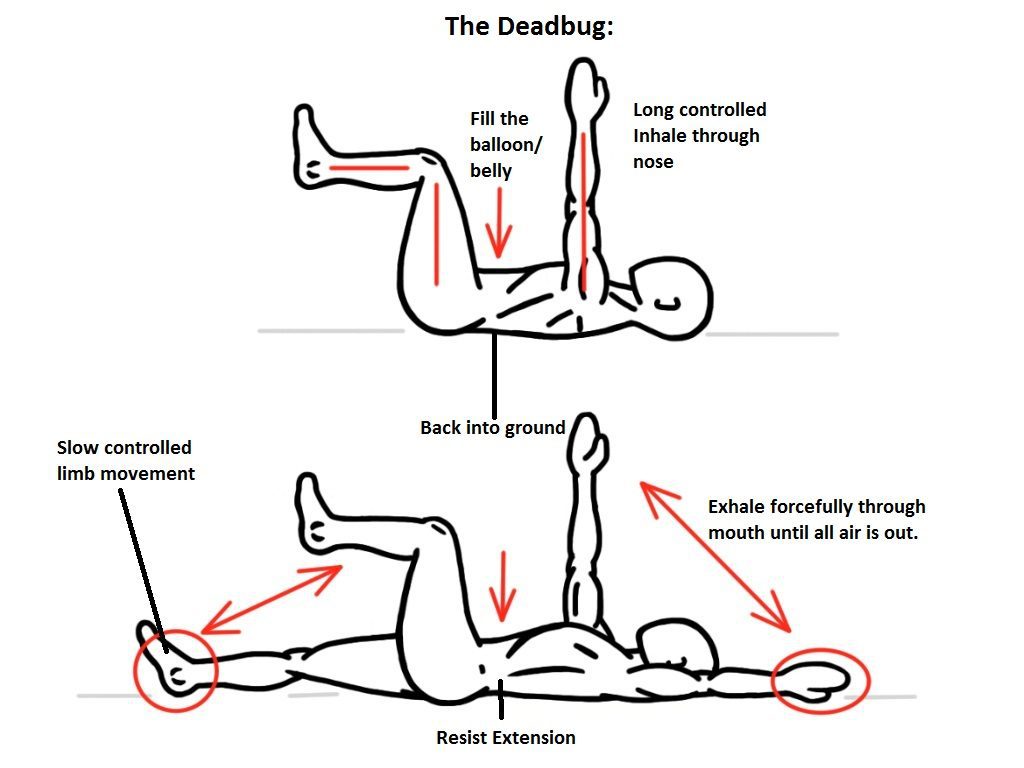
1. Dead bugs
Dead bugs are a great exercise as they can help teach anti-extension positioning. The aim is to lie flat on your back with your legs and arms up ‘like a dead bug on the floor’. Next, whilst keeping your spine in neutral you need to slowly lower one heel to the ground at a time whilst not allowing your spine to drift into extension.
Implement this with breathing out as you bring your limbs back upwards for 3 sets of 10.
2. Plank
Who could forget the good ole plank!? When done correctly the plank is a great anti-extension exercise that promotes core strength. How to do it?
– Plant your forearms on the ground and align your elbows under your shoulders
– Position your trunk, upper body and hips parallel with the ground
– Brace your abdomen and keep your core tight
– For an extra challenge you can place an empty cup or a yoga block on the lower back
– You can progress the plank using a stability ball as well!

Try adding these two exercises to your gym routine. If you are having any trouble speak to your physiotherapist about the issue!
